Cricket bahisleri, özellikle Hint alt kıtasında ve İngilizce konuşulan ülkelerde büyük bir heyecan yaratır. BasariBet, bu geniş kitleye hitap eden kapsamlı ve rekabetçi bahis seçenekleri sunar. Bu rehber, BasariBet cricket bahis piyasalarını detaylı bir şekilde inceleyerek, bahis stratejinizi geliştirmeniz için gereken somut bilgileri sunacaktır.
Cricket Bahis Türleri ve Piyasaları
BasariBet platformunda, cricket meraklıları için çok çeşitli bahis türleri mevcuttur. En yaygın olanı, bir maçın sonucunu tahmin etmeyi içeren “Maç Kazananı” bahsidir. Bunun yanı sıra, “En İyi Toplayıcı (Top Run Scorer)” ve “En İyi Wicket Alan Oyuncu (Top Wicket Taker)” gibi oyuncu bazlı piyasalar da büyük ilgi görür. IPL veya T20 Dünya Kupası gibi büyük turnuvalarda, “Turnuva Kazananı”, “Grup Aşamasına Çıkacak Takım” ve “Serinin En Değerli Oyuncusu (MVP)” gibi özel bahis seçenekleri de bulunur. Her bir piyasanın oranları, takımların formu, oyuncu istatistikleri ve saha koşullarına göre dinamik olarak güncellenir.
Canlı Bahis (Live Betting) Stratejileri
BasariBet’te cricket canlı bahisleri, maç sırasında heyecanı katlayan bir deneyim sunar. Oranlar, her atılan top ve her skor değişikliği ile anlık olarak güncellenir. Başarılı bir canlı bahis stratejisi için maçı dikkatle izlemek ve momentum değişimlerini yakalamak çok önemlidir. Örneğin, powerplay overs sırasında hızlı koşu oranı veya bir wicket düştükten hemen sonra yeni bir batsmanın performansı üzerine bahis oynayabilirsiniz. Canlı bahislerde karar verme süreniz kısıtlıdır, bu nedenle platformun kullanıcı dostu arayüzü ve hızlı yüklenen oranları büyük bir avantaj sağlar.
BasariBet Bonus ve Promosyonları Kullanma
Cricket bahislerinizin değerini artırmak için BasariBet bonus tekliflerinden yararlanmak akıllıca bir harekettir. Yeni kullanıcılar, kayıt olduktan sonra hoş geldin bonusu alabilirler. Mevcut kullanıcılar için ise, önemli cricket maçları öncesinde sunulan özel promosyonlar ve free spin fırsatları bulunur. Herhangi bir bonusu talep etmeden önce, bahis şartlarını ve çevrim gereksinimlerini mutlaka okuyun. Örneğin, 5x çevrim gerektiren bir bonus, bonus tutarını 5 kez bahis yapmanız gerektiği anlamına gelir. Unutmayın, bir BasariBet promo code kullanmanız gereken teklifler için kodu kayıt veya para yatırma işlemi sırasında ilgili alana girmelisiniz.
Belge Türü
Amaç
Doğrulama Süresi
Kimlik Kartı (Ön/Yan)
Yaş ve Kimlik Doğrulama
24 saat içinde
Adres Beyanı (Fatura)
İkametgah Doğrulama
24-48 saat
Ödeme Yöntemi Ekran Görüntüsü
Ödeme Hesabı Mülkiyeti
24 saat içinde
Hesap Doğrulama ve Para Çekme İşlemleri
BasariBet casino ve spor bahisleri platformunda sorunsuz işlemler için hesap doğrulama şarttır. İlk para çekme talebinizde, KYC (Know Your Customer) sürecini tamamlamanız istenecektir. Aşağıda, sunmanız gereken tipik belgelerin bir listesi bulunmaktadır:
Geçerli bir kimlik kartı veya pasaport
Son 3 ay içinde alınmış bir elektrik, su veya internet faturası (adres kanıtı için)
Kullanılan kredi kartının (yalnızca son 8 hanesi görünecek şekilde) veya e-cüzdan hesabının ekran görüntüsü
Para çekme talepleri, doğrulama tamamlandıktan sonra genellikle 24 saat içinde işleme alınır. Banka havalesi 3-5 iş günü, e-cüzdanlar ise 24 saat içinde hesabınıza ulaşabilir.
Sık Karşılaşılan Sorunlar ve Çözümleri
Kullanıcıların karşılaştığı yaygın sorunlardan biri, bonusların hesaba yansımamasıdır. Bu genellikle bir BasariBet no deposit bonusu için ek bir kayıt adımı gerekiyorsa veya para yatırma bonusu için minimum yatırım miktarı karşılanmamışsa olur. Çözüm için müşteri hizmetleriyle iletişime geçmek en iyisidir. Diğer bir sorun, canlı bahis sırasında oranların gecikmeli güncellenmesidir; bu durumda sayfayı yenilemek sorunu çözebilir. Tüm bu konularda daha fazla kullanıcı deneyimi okumak için, BasariBet yorumlar içeren güvenilir kaynakları inceleyebilirsiniz. Müşteri hizmetlerine ulaşmanın en hızlı yolu canlı sohbet özelliğidir ve 7/24 hizmet vermektedir.
Güvenlik ve Sorumlu Bahis
BasariBet, lisanslı bir operatör olarak kullanıcı verilerini SSL şifreleme teknolojisi ile korur. Kişisel ve finansal bilgileriniz üçüncü şahıslarla paylaşılmaz. Sorumlu bahis, platformun önceliklerinden biridir. Günlük, haftalık veya aylık para yatırma limitleri koyabilir, kendinizi soğutma sürecine alabilir veya hesabınızı kalıcı olarak kapatmak için müşteri hizmetleriyle iletişime geçebilirsiniz. Bahis, bir eğlence aktivitesi olarak kalmalı ve kişisel bütçenizi asla aşmamalıdır. basaribet, kullanıcılarına her zaman güvenli ve kontrollü bir ortam sunmayı taahhüt eder.
Stap-voor-stap Gids: Tweefactorauthenticatie (2FA) Instellen op Winbet
Online veiligheid is van cruciaal belang, zeker wanneer het om jouw account bij een online casino gaat. Het instellen van tweefactorauthenticatie (2FA) op jouw Winbet account is een van de meest effectieve manieren om ongeautoriseerde toegang te voorkomen. Deze gids legt in duidelijke stappen uit hoe je deze extra beveiligingslaag activeert, zodat je met een gerust hart kunt spelen.
Wat is tweefactorauthenticatie en waarom is het belangrijk?
Tweefactorauthenticatie is een beveiligingsmethode waarbij je twee verschillende manieren gebruikt om je identiteit te verifiëren voordat je kunt inloggen. Meestal is dit iets wat je weet (je wachtwoord) en iets wat je hebt (een code op je telefoon). Dit biedt een enorme extra bescherming. Zelfs als iemand je wachtwoord zou stelen, kunnen ze niet inloggen zonder die unieke code. Voor een platform als Winbet casino, waar persoonlijke gegevens en financiële transacties centraal staan, is dit een absolute must-have voor serieuze spelers.
Voorbereiding: Wat je nodig hebt voordat je begint
Voordat je 2FA instelt, moet je een paar dingen gereed hebben. Zorg allereerst dat je toegang hebt tot je Winbet account met je huidige inloggegevens. Daarnaast heb je een smartphone nodig. Je gaat namelijk een authenticator-app installeren. Populaire en betrouwbare keuzes zijn Google Authenticator of Authy. Deze apps zijn gratis te downloaden in de App Store of Google Play Store.
Je Winbet inlognaam en wachtwoord.
Een smartphone (iOS of Android).
Een geïnstalleerde authenticator-app zoals Google Authenticator.
Een stabiele internetverbinding.
Stap-voor-stap instructie voor het instellen van 2FA
Volg deze stappen zorgvuldig om de tweefactorauthenticatie correct te activeren.
Log in op je account bij Winbet.
Navigeer naar ‘Mijn Account’ of ‘Accountinstellingen’.
Zoek naar de optie ‘Beveiliging’ of ‘Tweefactorauthenticatie’.
Klik op de knop om 2FA in te schakelen.
Er verschijnt een QR-code op je scherm. Open nu de authenticator-app op je telefoon.
Scan de QR-code met de app. De app voegt dan Winbet toe en genereert een 6-cijferige code.
Voer deze code in op de Winbet website om de koppeling te bevestigen.
Sla de herstelcodes die Winbet aanbiedt op een veilige plek op. Deze heb je nodig als je je telefoon kwijtraakt.
Vanaf nu wordt er bij elke inlogpoging om een code uit je authenticator-app gevraagd.
Veelvoorkomende problemen en oplossingen
Soms loopt het installatieproces niet helemaal soepel. Hier zijn de meest voorkomende problemen en hun oplossingen.
Probleem
Oorzaak
Oplossing
QR-code scannen werkt niet
Onscherpe camera of slechte lichtomstandigheden.
Probeer het opnieuw in goed licht of kies voor ‘kan code niet scannen’ en voer de sleutel handmatig in.
Code wordt niet geaccepteerd
De tijd op je telefoon staat niet goed gesynchroniseerd.
Zorg ervoor dat de klok op je telefoon op ‘Automatische tijd’ is ingesteld.
Toegang tot account kwijt
Telefoon kwijt of app data gewist.
Gebruik de herstelcodes die je hebt opgeslagen of neem contact op met de klantenservice van Winbet.
Extra beveiligingstips voor je account
Naast 2FA zijn er andere manieren om je account veilig te houden. Gebruik altijd een sterk, uniek wachtwoord dat je nergens anders gebruikt. Wees voorzichtig met phishing-e-mails die vragen om je gegevens; een officieel bedrijf als Winbet zal nooit om je wachtwoord vragen per e-mail. Houd ook de software van je apparaat up-to-date. Het is vermeldenswaard dat een sterke beveiliging ook voordelen heeft voor het benutten van acties, zoals het veilig claimen van een Winbet bonus of het gebruik van een Winbet promo code. Hoewel een Winbet no deposit aanbod weinig risico met zich meebrengt, verdienen zelfs Winbet free spins de bescherming van een goed beveiligd account. Voor alle actuele promoties en om je beveiligde account te gebruiken, kun je terecht op de officiële website van Winbet.
Conclusie: Veilig spelen is beter spelen
Het instellen van tweefactorauthenticatie op Winbet is een eenvoudig proces dat slechts een paar minuten kost, maar je accountbeveiliging aanzienlijk verbetert. Het biedt gemoedsrust, zodat jij je kunt concentreren op wat echt belangrijk is: genieten van het spel. Door deze extra moeite te nemen, toon je dat je een verantwoordelijke speler bent die de veiligheid serieus neemt.
Casoola Auto-Deposit Feature: Veiligheid en Instellingen
Wat is de Auto-Deposit functie van Casoola?
De Auto-Deposit functie, beschikbaar bij Casoola casino, is een handige tool waarmee spelers automatisch geld kunnen storten volgens een vooraf ingesteld schema. In plaats van elke keer handmatig een storting te doen, kun je de functie zo configureren dat dit automatisch gebeurt. Dit is ideaal voor spelers die graag hun budget willen beheren en geen stortingen willen vergeten. Het belangrijkste voordeel is het gemak, maar ook de veiligheid staat voorop. Het systeem is ontworpen met sterke encryptie om je financiële gegevens te beschermen. Er zijn wel limieten ingesteld om verantwoord spel te bevorderen, zoals een maximale wekelijkse of maandelijkse stortingslimiet die je zelf kunt aanpassen.
Hoe stel je Auto-Deposit stap voor stap in?
Het instellen van de automatische storting is een eenvoudig proces. Volg deze handleiding om het correct te configureren.
Log in op je account bij Casoola.
Navigeer naar de ‘Bank’ of ‘Mijn Account’ sectie.
Selecteer de optie ‘Auto-Deposit’ of ‘Automatische Stortingen’.
Kies je voorkeursbetaalmethode (bijv. iDEAL, creditcard, Skrill).
Voer het bedrag in dat je regelmatig wilt storten.
Stel de frequentie in: dagelijks, wekelijks of maandelijks.
Stel een startdatum in en bevestig de limieten.
Review en accepteer de voorwaarden om de instelling te activeren.
Na activering ontvang je een bevestigingsmail. Wij raden aan om eerst een kleine teststorting te doen om te controleren of alles correct werkt.
Veiligheidsmaatregelen en verificatie
De veiligheid van je transacties is de hoogste prioriteit. Casoola maakt gebruik van SSL (Secure Socket Layer)-encryptietechnologie van bankkwaliteit. Dit betekent dat al je gegevens worden gecodeerd verzonden en ontoegankelijk zijn voor derden. Voordat je Auto-Deposit kunt gebruiken, moet je account volledig geverifieerd zijn volgens de KYC (Know Your Customer)-richtlijnen. Dit is een essentieel onderdeel van de veiligheid. De documenten die je moet uploaden zijn:
Een geldig identiteitsbewijs (paspoort, rijbewijs of ID-kaart).
Een recente energierekening of bankafschrift als bewijs van adres.
Een kopie van de voor- en achterkant van je betaalpas of creditcard (indien gebruikt).
Deze verificatie is eenmalig en zorgt ervoor dat alleen jij toegang hebt tot je account en betaalgegevens.
Veelvoorkomende problemen en oplossingen
Soms kunnen zich problemen voordoen. Hier is een overzicht van veelvoorkomende issues en hoe je ze kunt verhelpen.
Probleem
Mogelijke Oorzaak
Oplossing
Storting wordt niet uitgevoerd
Onvoldoende saldo, verlopen betaalmethode, of verkeerde instellingen.
Controleer je banksaldo, update je betaalgegevens en controleer de Auto-Deposit instellingen.
Verificatie is vertraagd
Documenten zijn onduidelijk, incompleet of niet geldig.
Upload hoge kwaliteit, volledige kopieën van de vereiste documenten.
Foutmelding ‘Transactie geweigerd’
Tijdelijke storings bank, verdachte activiteit, of overschrijding limiet.
Wacht even en probeer het opnieuw, of neem contact op met de klantenservice.
Kan Auto-Deposit niet vinden
Functie is niet beschikbaar in je regio of voor je accounttype.
Neem contact op met de klantenservice om je beschikbaarheid te controleren.
Voordelen en aandachtspunten
De grootste voordelen van Auto-Deposit zijn consistentie in budgetbeheer en gemak. Je hoeft niet meer elke keer in te loggen voor een storting. Het kan je ook helpen om in aanmerking te komen voor bepaalde aanbiedingen, zoals een terugkerende Casoola bonus. Echter, er zijn ook aandachtspunten. Zorg ervoor dat je voldoende saldo op je betaalrekening hebt staan om de automatische incasso te dekken, anders kunnen er kosten van je bank in rekening worden gebracht. Je kunt de functie op elk moment pauzeren of uitzetten. Vergeet niet dat deze service bedoeld is om verantwoord spelen te vergemakkelijken, niet om het te stimuleren. Stel realistische limieten in.
Combinatie met bonussen en promoties
Het gebruik van Auto-Deposit kan slim worden gecombineerd met promoties. Sommige bonussen zijn specifiek bedoeld voor spelers die deze functie gebruiken, zoals een extra percentage op je automatische storting. Het is belangrijk om de promotievoorwaarden zorgvuldig te lezen. Een Casoola no deposit aanbod vereist uiteraard geen storting. Voor andere acties, zoals het gebruik van een Casoola promo code voor een welkomstbonus, kun je de eerste handmatige storting doen en daarna overschakelen naar Auto-Deposit. Als een aanbod Casoola free spins bevat, controleer dan of deze ook beschikbaar zijn bij automatische stortingen. Ga naar de website van Casoola om de laatste promotievoorwaarden te bekijken en te zien wat het beste bij jouw speelstijl past.
The Way We Are Righteous Stacks Up Against Rival Streetwear Brands
Streetwear shoppers in 2026 have more options than ever, and this glut of options makes side-by-side evaluation essentially mandatory before spending. Ask five people what defines “good streetwear” and you will get a handful of clashing opinions involving cut, material heft, release cadence, or brand narrative. This piece breaks down where the Righteous label fits into this debate, using hard particulars rather than generic compliments. We’re going to dig into what the Righteous clothing brand really brings to the table, how it situates itself against rival names in streetwear, and what common threads show up in most reviews of the brand. No fabricated stats, no gaps papered over — just a straightforward take on how Righteous compares when you are deciding where to spend your money.
The Substance Behind What We Are Righteous Truly Represents
We Are Righteous constructed its brand persona around an uncomplicated belief: garments ought to carry substance without shouting about it. The Righteous apparel line relies on clean graphics, considered typography, and a tone that feels more intentional than trend-chasing. The reason this counts is that a large portion of labels in the space follow a formulaic template — take a popular silhouette, slap a logo on it, ship it fast. Righteous clothing takes a slower approach, which is reflected in the way pieces are described and marketed rather than pushed out in rapid, frequent drops.
How the label named itself is already a statement. “We Are Righteous” as an identity choice is anything but quiet, and that is by design. Streetwear has always used language as a badge, and the brand keeps that custom alive by turning its name into a declaration instead of a shorthand. People looking up “we are righteous brand” online will generally come across a catalog that centers on printed tees, hoodies, and outerwear that feel deliberate rather than throwaway.
Contrast this with righteou brands whose whole foundation is hype — the kind that depend on artificial scarcity and markup resale to build noise. Righteous does not appear to chase that same playbook as aggressively, which transforms the whole dynamic with buyers. Purchases happen out of genuine liking for the item, not resale intent. This single difference splits a portion of the streetwear world into two distinct groups, and Righteous sits closer to the side favoring everyday wear over speculation.
Righteous’s Hoodie as a Case Study
When it comes to judging any streetwear brand, a hoodie ranks as the most revealing product, since it lays bare everything about how the piece is built. A brand can glam up a t-shirt with smart graphics, but a hoodie gives away weak seams, thin fleece, and a careless cut within just one wash. The Righteous hoodie line gets referenced often in a Righteous review context because hoodies remain the anchor product for most streetwear collections, Righteous included.
What shoppers tend to flag in reviews is reliable fit and where the graphics sit — a pair of details where low-cost streetwear labels often skimp. A hoodie that shrinks unevenly or prints that crack after a handful of washes will tank a brand’s reputation faster than almost anything else. How Righteous handles its hoodie releases signals careful attention to these details, framing the product as a long-term closet essential instead of a fad piece that fades after one season.
It’s worth pointing out that hoodie pricing throughout the streetwear market swings dramatically — certain labels fall into the budget tier, others push into premium territory north of $150 per piece. Without a fixed price point published here, the fair comparison point is positioning: Righteous presents itself as approachable streetwear built with deliberate design, not as a near-luxury brand hunting for four-figure resale prices. That puts it in competition with a specific tier of the market rather than the entire spectrum.
How Righteous Stacks Up Against Other Streetwear Brands
The following table lays out the comparison points that matter most to streetwear shoppers: design philosophy, product focus, drop frequency, and community vibe. These are the elements that really determine whether satisfaction lasts six months after buying, and not merely at the moment you open the box.
Category
We Are Truly Righteous
Hype-Driven Streetwear Brands
Fast-Fashion Streetwear Labels
Design Philosophy
Purpose-led design with a steady brand voice
Trend-reactive, logo-first
Copy-paste of viral styles
Main Product Focus
Hoodies, printed tees, and outerwear pieces
Scarce collaborations and exclusive drops
Wide-ranging catalog with little differentiation
Drop Frequency
Considered, less rushed
Regular limited-quantity releases
Constant, high-volume restocks
Resale Market Presence
Little emphasis placed on resale
Core to how the brand operates
Seldom relevant
Community Feel
Values and identity-based
Status and access-based
Driven by price, with little loyalty
One clear takeaway from this table is this: Righteous is not trying to win the same contest as labels chasing hype and resale markups, nor is it going up against rivals on the lowest possible pricing against mass-market streetwear brands. It carves out a middle ground — identity still matters, but so does creating pieces people genuinely keep wearing. In a market that typically makes shoppers choose between “overpriced hype” and “cheap and forgettable,” that middle lane remains largely untapped.
What Shows Up in a Typical Righteous Review
Customer reviews are where marketing claims get tested against reality, and a handful of consistent threads keep showing up across Righteous’s review content. The first recurring theme is the way people react to the brand’s tone — unlike the average streetwear name, the messaging here builds around a set of values rather than aesthetics alone. Also common are comments about sizing and fit, an unsurprising pattern for any hoodie-and-outerwear brand, since fit naturally varies depending on individual body shape.
Moving to the third point, and this is where a review of We Are Righteous tends to get particular, customers discuss whether the artwork and print craftsmanship hold up over time. Fans of streetwear are especially watchful of this detail because they have been burned before by brands whose prints lift or wash out within a dozen washes. What keeps surfacing in most reviews is that Righteous treats durability and print quality as a core focus, which echoes the brand’s slower, more intentional release approach noted above.
Fourth, shipping and customer service experiences shape review sentiment as much as the product itself — this holds true industry-wide, not just for Righteous. A shopper who loves a hoodie but has a rough delivery experience will often leave a mixed review, which is why judging any streetwear brand purely on product photos is incomplete. Reading a range of reviews rather than a single glowing or scathing one gives a far more accurate picture of what to expect.
How Righteous Clothing Fits within 2026’s Urban Fashion World
As of 2026, the streetwear scene has grown more splintered compared to half a decade back. New micro-brands surface weekly via social platforms, veteran brands jostle for visibility in multi-brand stores, and the resale economy has converted scarcity from an accidental outcome of tight production into a calculated marketing lever. Amid this environment, Righteous clothing brand’s calmer strategy distinguishes itself by refusing to deploy every trick in the hype playbook.
This matters in real terms for those making a purchase. If you are someone who wants a hoodie you will wear for two winters rather than one season, a brand not solely engineered around release-day mania is the steadier option. Should your priority be flipping items for profit or building a collector’s reputation, Righteous likely isn’t shaping itself around that kind of buyer — and that’s a reasonable trade-off worth knowing before you purchase rather than discovering it afterward.
At the end of the day, the comparison essentially hinges on what you are shopping for. The streetwear world has divided into a handful of separate sub-categories: status-driven hype culture, budget-driven fast fashion, along with in-between labels built around identity. Via a sufficiently clear voice, We Are Righteous occupies that middle space, which means shoppers digging for “righteous” or “we are righteous brand” online land on a coherent story instead of a scattershot catalog chasing every trend simultaneously.
For anyone weighing Righteous apparel against competitors, the smartest approach is treating this comparison as a starting point, not a final verdict. Read current reviews, check fit notes on the product pages you’re actually considering, and weigh that information against what matters most to you — whether that’s construction quality, brand values, or simply finding a hoodie that will still look good next winter.
The Fabric Narrative: What HMDD Says About Its Fabric Choices
Across street-fashion communities, HMDD, the label has built a name for itself by approaching material choice like part of the brand’s storytelling, rather than an afterthought buried in a size guide — short for “Happy Memories Don’t Die.” Since the pieces are positioned as sentimental items you put on, the materials must come across as something worth keeping for the concept to work. People searching for an hmdd review repeatedly arrive at the identical query: is the fabric truly on par with the emotional weight of the brand messaging, or is it just another logo-driven drop riding on sentimental appeal? This article looks at what HMDD conveys about its materials, how those choices show up in specific categories like hmdd sweatpants and hmdd shorts, and what it all adds up to for anyone weighing up whether to invest in 2026.
The textile itself is the one component that a buyer is unable to properly evaluate from a product photo. Shade, tailoring, and graphic are immediately apparent; weight, drape, and how a blend behaves after a dozen washes are not. Candor defines how HMDD communicates on this front — listings and marketing materials consistently highlight fabric composition, construction detail, and the intended feel of each piece. As consumers have grown more knowledgeable about materials and less willing to accept vague marketing language like “premium quality” without a supporting number or spec, that approach matters more in 2026 than it did five years ago.
How Material-Centered Discussion Established Itself as the Backbone of the HMDD Identity
Scrutiny is invited since heart-tugging brand messaging comes into play, and that line “happy memories don’t die” is emotionally loaded by intent. Should a hoodie be designed to feel like a hmdd la tee tangible memory, it must hold up under the demands of actual daily living — the laundry cycle, regular rotation, shifting weather. The way HMDD has met that demand has been to speak candidly on what goes into every item, rather than leave shoppers to speculate. Such transparency is a purposeful positioning choice: fans of streetwear have grown wary of brands that depend wholly on graphics and drop scarcity while saying little about construction.
That wary reaction is backed by data. Trade research on clothing-buying habits repeatedly reveal that a large share of digital consumers — commonly noted as surpassing 60% — read the materials section ahead of completing their order, particularly with hoodies and jackets priced above budget basics. HMDDLA’s lineup, spanning hoodies, tees, sweatpants, and shorts, is positioned at a price tier where shoppers assume that information should be present and precise. Staying quiet on what a garment is made of at that tier is perceived as a red flag; specificity reads as confidence.
A practical angle around retention exists too. A one-time hmdd clothing buyer who feels let down by the fabric will rarely turn into a repeat customer—no matter how strong the emotional branding proves to be. Fabric quality is what transforms an looks-based one-time purchase into a trust-driven loyalty purchase. That’s likely why the brand’s product descriptions repeatedly return to fabric weight, blend ratios, and finishing details rather than treating them as fine print.
Joggers as well as Shorts: Where Your Choice of Fabric Is Most Visible
Sweatpants and shorts are unforgiving categories for fabric mistakes. A hoodie can hide a slightly stiff fabric under looser styling, but sweatpants sit against the skin for hours and shorts see far more movement and friction. HMDD sweatpants are positioned in the brand’s lineup as an everyday-comfort item, which puts direct pressure on the fleece or blend used inside them to perform in three ways: softness against skin, retention of shape after repeated wear, and breathability during warmer months.
HMDD shorts fulfill a somewhat different purpose — they’re designed for reduced-weight, freer-moving wear, and the label’s copy for these items typically foreground a more relaxed hand-feel and less bulk when set against the sweatpants line. This difference has real practical weight: a shopper buying for layering in cooler months wants the sweatpants’ heavier construction, while for spring or summer rotation, the shorts’ lighter design is the better fit. The brand’s own product copy generally reflects this split rather than treating all bottoms as interchangeable.
More than people expect, cut and material work together. A cotton-dominant weave with barely any stretch will drape differently than a version that includes elastane, and HMDD’s sizing notes alongside its material descriptions are meant to help shoppers anticipate that effect before they order. Here, looking closely at the specific listing matters more than skimming a general brand review, since the blend composition can vary between releases and collections tied to a season.
To Customers, This Is What “Best HMDD Clothing” Actually Stands For
What shoppers are genuinely asking when they search for the highest-rated hmdd clothing isn’t which one piece inherently outperforms the rest — it’s about which pieces give the most consistent value for the cost involved, rooted in fabric performance over time. That proves to be a reasonable way to think about it, because value in clothing is really a ratio: the price split across the number of good wears you get that you get before the garment loses its color, loses its shape, or develops pilling.
Once it’s correctly treated, cotton-rich fleece holds up against pilling more effectively than budget poly-cotton blends cut with lower-grade fibers. Brands that specify their blend ratio — say, a majority cotton percentage against a minority synthetic for shape retention — are handing customers the means to gauge that longevity themselves. The way HMDD names fabric details on product pages, rather than relying on lifestyle imagery alone, aligns with this more transparent model of streetwear retail that has turned into the norm by 2026.
Uniform fit across sizing is yet another understated sign of a soundly built line. When a buyer picks up a medium hoodie and a medium sweatpant and both keep fitting properly through repeated washes, that’s the reward of consistent fabric sourcing showing itself. Inconsistent sourcing — where a given batch drifts slightly from the blend used before it — is a recurring complaint in any streetwear review, and it’s the kind of problem careful fabric record-keeping is meant to prevent.
Weighing Fabric Priorities Across HMDD’s Core Categories
Various types of garments place different demands on fabric, and HMDD’s lineup shows as much rather than applying a single blend to every item. The table below summarizes how HMDD’s declared priorities tend to vary by category, according to its own product messaging.
Product Type
Chief Fabric Concern
Usual Wear Scenario
Main Shopper Concern
Hoodies
Fabric weight paired with warmth-holding ability
Layering in cold conditions
Shrinking after repeated washing
HMDD Sweatpants
Plushness combined with shape-holding
Routine, comfort-driven wear
Long-term stretch retention in waistband and cuffs
HMDD Shorts
Ventilation and minimized bulkiness
Warm-weather, high-mobility wear
The balance between lightness and durability
Tees
Touch and the way it drapes
Standard base-layer wear
Color retention through multiple washes
This sort of category-specific approach is a more convincing signal of a earnest clothing brand than a single blanket claim of “high quality fabric” applied to every product page. It suggests deliberate trade-offs are being made by the design team rather than falling back on whatever textile is most economical to procure at scale.
What an HMDD Review Actually Reveals Beneath the Surface
Nearly every HMDD review comes back around to two points: does the sentiment-driven branding feel genuine, and does the product physically hold up. Fabric sits at the intersection of both, because a garment that wears out fast undermines the “memories don’t die” premise in the plainest, most literal sense. A buyer who embraces that premise expects the physical item itself to hold up over time, not just have the copy strike a chord for the span of one Instagram post.
When unaffiliated reviewers talk about hmdd clothing, material thickness is one of the most commonly cited specifics — thicker fleece is commonly taken as a signal of money put into the garment, while thinner cotton blends are judged more on price point relative to expectation. That’s a reasonable heuristic, but it’s not the whole picture; finishing quality, stitching density, and colorfastness matter just as much as raw fabric weight, and those specifics tend to come out only through reviews from people who’ve actually worn and washed the piece multiple times, not just opened the package.
If you’re weighing hmdd against other streetwear brands going after that same nostalgic, memory-driven positioning, the real-world test is straightforward: check the precise material breakdown for that specific item instead of leaning on the label’s broader name. A hoodie’s blend won’t tell you how the shorts will perform, and a glowing review of one release is no promise that the next drop uses the same sourcing.
The Takeaway Heading Into 2026
Clarity around material composition is no longer optional for streetwear brands competing at HMDD’s level — it’s almost table stakes now among shoppers who’ve learned the hard way from vague listings. Labels that spell out blend ratios, material weight, and category-specific priorities are providing a more equitable way for buyers to compare than brands depending only on aesthetics and tagline charm.
Spanning its sweatpants, shorts, hoodies, and tees, HMDD’s continued emphasis on fabric-specific messaging suggests the brand recognizes that its “happy memories don’t die” concept only works if the product physically supports the sentiment. In the end, how well the message matches the material is the most valuable thing a would-be buyer can weigh before checking out in 2026.
Prestige 2027 Unveiled: What’s Coming In the Label’s Upcoming Era
The market starts asking tougher queries about a fashion label from time to time — and heading into 2027, that’s exactly where Prestige stands. Those googling “what is Prestige” currently come across a brand that has moved from a niche streetwear curio to an established name in relaxed and elevated staples. The change was far from sudden. It happened through a gradual build-up of decisions on product, a tightening of the Prestige collection structure, and a readiness to reject fads inconsistent with its core identity. This article looks at what the next stage probably has in store, based on what the brand has already shown, not conjecture presented as fact.
If you’re just discovering the label, consider Prestige as a brand constructed around everyday essentials rather than seasonal flash. In particular, the Prestige hoodie line has emerged as the flagship item that most new customers encounter first, frequently through word of mouth or a Prestige review posted to a community forum rather than a paid ad. The brand’s 2027 output roadmap is informed by this grassroots pattern of discovery, which carries weight precisely because it leans toward focus in categories already working rather than unfocused experimentation.
Where Prestige Clothing Is Positioned At This Moment
Before turning to the future, it helps to look at where Prestige clothing sits today. Prestige relies on its own Prestige store channels as its chief sales prestige store route, maintaining a narrower distribution footprint than many rivals that stretch themselves across numerous marketplaces. This reflects a deliberate choice. Tighter distribution means the brand controls presentation, pricing consistency, and the pace of new drops, and this, in turn, molds how customers perceive scarcity and quality.
In this moment, six elements define the current era of Prestige’s clothes—and every one of them extends into the 2027 outlook:
A central emphasis on hoodies, sweatshirts, and foundational layering items rather than trend-driven pieces that shift fast.
The Prestige store serves as the chief purchasing channel for direct-to-consumer sales.
Rather than ongoing bulk replenishment, releases happen in limited runs.
A customer base that is weighted toward repeat buyers as opposed to single-purchase impulse buyers.
For newcomers to the brand, community-driven reviews act as the primary trust indicator.
A gradual, carefully-paced rate of expansion relative to rivals in fast fashion.
Since brands rarely abandon a method that is already paying off, each of these factors offers useful signal for anticipating what 2027 will bring. In its place, they polish it further, which is precisely the trend visible in Prestige’s recent collection cadence.
Thoughtful Expansion Emerges
Eroding a brand’s sense of self is a frequent hazard tied to growth for growth’s sake, but Prestige looks to be avoiding this pitfall. In place of releasing a monthly deluge of new SKUs, the brand has favoured fewer releases with more attention to construction and fit. This strategy demands more upfront planning, though it rewards the brand with stronger customer retention, given that shoppers who feel a brand is consistent are considerably more apt to make repeat purchases.
Expect 2027 to bring a similar rhythm: collections launched seasonally in reduced quantities, each one refining rather than replacing the last. This is not a brand chasing every micro-trend that appears on social feeds. Rather, it’s a brand banking on consistency snowballing into loyalty, a wager already validated by the gradual climb in repeat purchase rates noted informally throughout customer reviews.
Likely Implications of Prestige 2027 for Product Lines
“Prestige 2027” is already a phrase circulating as shoppers try to forecast the label’s upcoming moves, with the most sensible predictions landing in a few concrete areas rather than sweeping reinvention. As a first point, expect sustained attention to hoodies as a category, since it stays the piece most closely linked to what the brand represents and the one most frequently mentioned in a Prestige review. As a second point, expect the collection structure to stay seasonal rather than constant, maintaining the anticipation that has worked in the brand’s favour.
Third, a point worth keeping an eye on, expect small, steady upgrades to fabric weight and fit reliability instead of a full overhaul of silhouettes. Brands that have built trust on fit rarely gamble that trust away. As a fourth point, expect the Prestige store itself to see meaningful refinement, with product pages and sizing guidance shouldering more of what customer service now does manually. As a fifth point, limited-run colourways will probably keep serving as the tool for building urgency, rather than relying on continuous markdowns. As a sixth point, community feedback loops, meaning the reviews and comments shoppers leave, will go on determining which pieces end up reordered and which fade out of the lineup without fanfare.
None of this suggests dramatic reinvention. It suggests a brand doubling down on what has already proven to resonate, while smoothing out the rough edges that early growth stages typically leave behind.
Prestige Versus Similar Direct-to-Consumer Brands
Context is essential when assessing any brand’s trajectory, making it worthwhile to compare Prestige with the wider category of direct-to-consumer casualwear labels it goes up against. Below, a table lays out typical traits across three common strategies in this space: a selectively curated brand along the lines of Prestige, a high-output fast-fashion rival, and a traditional retail-distributed label.
Defining Feature
Curated DTC Setup in the Prestige Mold
Fast-Fashion Competitor
Traditional Retail-Distributed Brand
Drop Rhythm
Seasonal, small-batch runs
Weekly or continuous
Twice a year, sizable batches
Main Distribution Channel
Brand-owned shop selling direct to consumers
Marketplace and its own site
Wholesalers and department stores
Key Trust Signal
Shopper reviews and returning buyers
Scale and competitive pricing
Retail presence combined with label heritage
What the Assortment Prioritizes
Core staples refined over time
Quick turnover built around the trend cycle
Moderate turnover spanning a wide-ranging catalog
Replenishment Pattern
Exclusivity-driven, held limited
Constant restocking
Restocking aligned with the seasonal calendar
Set side by side like this, the strategic logic behind Prestige’s decisions becomes clearer. By sticking to the curated-DTC path, the brand gives up outright volume for deeper connection with its customers, a trade that typically privileges lasting brand equity over short-term sales surges.
What Shoppers Should Look For When Buying
For those thinking about buying, a few useful habits reduce friction along the way and cut down the chance of disappointment. Reading a recent Prestige review before buying is worth the two minutes it takes, since notes on sizing and material from actual buyers tends to be more reliable than marketing copy. Confirming availability directly through the Prestige store is also wiser than trusting third-party resellers, who sometimes mark up limited releases substantially.
Consider these habits before you check out:
Check the most recent size guidance rather than relying on memory from a past purchase.
Look through several independent reviews rather than only the site’s featured testimonials.
Track restock updates if a specific piece from the collection goes out of stock fast.
Compare fabric descriptions across similar items to understand weight and drape variations.
Buy directly through official channels to avoid inflated resale pricing on limited drops.
These habits apply whether someone is buying their first Prestige hoodie or their 10th piece from the brand. Familiarity with the brand does not eliminate the value of due diligence, especially as new lines get introduced.
The Broader Outlook Heading Into 2027
Taking a wider view, the story of Prestige heading into 2027 is one of restraint rather than reinvention. The brand has built its identity on a focused set of product categories, a tightly managed sales channel, and a customer base that remains loyal enough to come back without heavy discounting or aggressive advertising. That base lacks flash, yet it endures, and staying power tends to beat hype over several-year timelines.
Even as cut, cloth, and shade choices evolve, shoppers who have stayed loyal to the line since its first collections will in all likelihood identify the DNA in whatever comes next. Newcomers researching “what is Prestige” for the first time should expect a label that pays off for the patient: a limited number of drops, each one deliberate, and a community of buyers whose write-ups carry actual clout in steering the catalog. Against the backdrop of brands claiming nonstop reinvention, this is a modest promise; still, Prestige has honored it consistently, and consistency is precisely what will define what comes next.
Tory Burch: The Queries That Keep Coming Up Answered
Hardly any label collects this much breezy inaccuracy, and the founder takes the worst of it: she is credited with a job title she does not hold, plus a career she never had. The shopping questions are messier again, because savings articles keep directing readers toward a channel that shut in 2026 and toward an online outlet the company denies operating. What follows confines itself to what could be verified and notes the points where sources disagree; the prices are observed market figures, read on the brand’s own site in September 2026 rather than taken from an official price list, and any claim resting on trade coverage instead of a company statement is labelled as such.
Who heads the company, and was the founder a designer before 2004?
Both halves of that are wrong: the chief executive role is not hers, and there was no design practice before it. Tory Burch is given the titles of Executive Chairman and Chief Creative Officer. Pierre-Yves Roussel, her husband, has held the chief executive job since 2019. Art history, not fashion, was the subject of her 1988 degree from the University of Pennsylvania, and the jobs that came next at Vera Wang, Polo Ralph Lauren and Loewe sat in advertising, communications and public tory-clothing relations, so the familiar line about a former Ralph Lauren designer is false. Her birth name was Tory Robinson, in Valley Forge, Pennsylvania, in the mid-1960s, and sources disagree, some saying 1966 and others 1967. The surname Burch is a married name retained after the 2006 divorce. Her mother, Reva Robinson, supplies the Reva flat its name, while the Robinson bag is named for both parents.
What is the start date of the brand, and how large has it become?
February 2004 is the founding date; the first store arrived in Nolita, in Manhattan, and the head office is still in New York. It launched under a name built on the founder’s initials before settling on Tory Burch. Company boilerplate carried through 2025 and 2026 describes around four hundred stores worldwide and roughly 4,800 employees as of 2024. Because the business is privately held and releases no financials, no revenue figure could be checked, and the totals posted across business blogs trace back to nothing. Approximately $3.3 billion resurfaces in article after article; that valuation dates from the minority investment completed in December 2012, so it is not current. Trade coverage references a modest single-digit revenue decline for fiscal 2025, a direction rather than a total.
Double T or T Monogram: how are the two not the same?
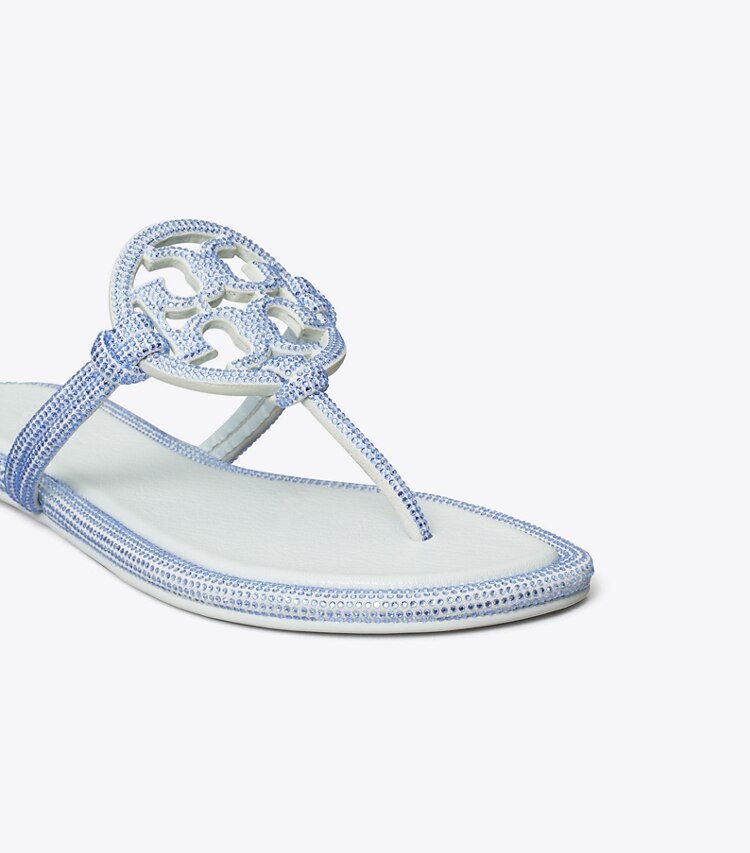
These are two distinct devices, and they get merged constantly. The Double T is the emblem: a serif T and its mirror image in a circle, used since 2004 as cast hardware and as the laser-cut cutout on the Miller sandal. The T Monogram is the later of the two and is something else entirely: an all-over repeating pattern carried on coated canvas, jacquard, knitwear and small leather goods, reported as introduced for Spring 2021. Spelling matters: Double T takes two capitals and no hyphen, and T Monogram is two capitalised words. It is not a monogram of the founder’s initials, since those initials are not two Ts. David Hicks, the English decorator, is cited as a formative influence; the Moroccan reference that keeps circulating applies to the pattern geometry, not to Hicks.
Which product names do articles get wrong?
A handful are mangled routinely. Paused in 2017 and relaunched in 2025, the Reva ballet flat returned as a redesign, with a wider toe, a larger logo plate and a mule option, priced at a reported $330 to $350 where the original was $195. The Robinson, the structured saffiano family named for the founder’s parents, was never discontinued and remains in production across several styles. Bombé is a shape modifier inside the Perry line rather than a collection of its own, as in the Perry Bombé Mini Bag, and the accent sits on the final letter. Tory Sport is alive too: it launched in September 2015 and now sits as a section of the main brand site rather than as a standalone destination with its own store network. Because Miller, Kira, Eleanor, Romy and Pierced each cover both bags and shoes, a question about any one of them is incomplete without a category. Introduction years for Kira, Fleming, Robinson, Ines and Romy cannot be traced, so the dates asserted confidently on blogs are guesses.
Is there an official tory burch outlet website?
There is none, and the company says as much in its own counterfeit guidance: no online outlet website exists. The authentic channels are limited: company stores, physical outlet stores, the brand website, and selected authorised department and specialty retailers. Physical outlets exist in premium outlet centres, including Woodbury Common, Cabazon, Carlsbad, Las Vegas and Silver Sands, and each can be checked against the official store locator. The rule is short: if a site calls itself the online outlet for this brand, it is not this brand. The company cautions that the usual reassurance signals prove nothing at all, a web address carrying the brand name included, along with professional photography, a claim of official status, or a very deep discount. Paid social and shopping ads, not organic search, funnel most of the people who lose money to these operations.
Where does a real tory burch sale come around?
The brand runs a recurring semi-annual sale, and coverage of the July 2026 edition described sandals under $100 and reductions of up to about half. Deeper claims of up to seventy percent read as the top of a marketing range rather than a standing offer. A separate private sale, gated to account holders and subscribers, is reported to run roughly twice a year, though that cadence could not be confirmed. Because tiered promotions surface seasonally, the fixed sale calendars on coupon and affiliate sites cannot be trusted. Off-price retail changed in 2026: Nordstrom Rack and TJ Maxx both carry the label and remain legitimate, while Saks OFF 5TH shut its e-commerce operation entirely after Saks Global’s bankruptcy early that year and now survives as roughly a dozen physical clearance locations. Poshmark, eBay, The RealReal and Vestiaire Collective are the other route to a lower price.
Made in China: does it mean counterfeit, and are there serial numbers on the bags?
No, and that mistaken test is the commonest of them all. Genuine production takes place in China, Italy and Portugal alike, and pieces made in Vietnam and India circulate too, which means country of origin cannot authenticate anything. The sources contradict each other on serial numbers: certain consignment authenticators say the bags carry none, while others report an interior tag with a style number followed by a two-digit month and year. Neither account has been settled, and where an interior code does exist it behaves like a style and production code rather than a unique serial. No official authentication service run by the company could be identified, and its published guidance is channel-based rather than marker-based. A dust bag, hangtag or box proves nothing, because all three are counterfeited and sold separately.
Do tory burch shoes fit small, and how much does tory burch clothing cost?
Buyers regularly say that the footwear runs narrow across the line, and that is buyer consensus rather than brand policy. The Miller sandal is most often called slightly small and narrow, with half a size up the usual advice, and a wide width exists for it. Reports on the Reva are mixed, though the common view is that it is shallow and narrow through the toe box. Shoe prices observed in September 2026 stretched from $150 for the Miller Cloud Light to $200 for the standard Miller sandal, with the classic loafer at $325. Observed ready-to-wear figures included $150 for a cotton scoop tank, $350 for slim leg jeans and $995 for a double breasted wool coat. Those are observed market prices, and the label sits in accessible luxury with an entry band around $95 to $200.
The Corrections, Summarised
What the table does is line up the most frequent claims alongside what the evidence supports. It summarises the answers above rather than replacing them, since several corrections need their context. Two entries matter more than the rest because they cost people money: the online outlet question, and the off-price channel that closed. Everything else is an accuracy problem, the kind that betrays a piece as soon as a reader checks. Nothing here counts as a company statement unless an answer above says so. Where the sources conflict, the table logs the disagreement rather than picking a winner.
Claim you will see
What checking supports
Tory Burch is the chief executive
Her titles are Executive Chairman and Chief Creative Officer, while Pierre-Yves Roussel has been chief executive since 2019
The brand runs an official online outlet
The physical outlet stores exist, yet the company states that it operates no online outlet website
Saks OFF 5TH is an online option
E-commerce there shut after Saks Global’s bankruptcy early in 2026; Nordstrom Rack and TJ Maxx are still options
Made in China indicates a fake
Genuine origins include China, Italy and Portugal, so origin cannot authenticate
A current valuation of $3.3 billion
That valuation comes from the December 2012 minority investment and is not current
Valentino Garavani Bags: The Complete Guide to the Entire Collection
Few leather goods are as instantly legible and as hard to summarise as a Valentino bag. The collection stretches from a raffia mini tote in the low four figures to an embroidered evening bag near eight thousand dollars, and both hold the same stamp inside. The collection is mapped here as it was in September 2026: the motifs and the shapes, the materials, the observed price bands and the way they move on resale. Treat every dollar figure as a market price observed on the brand’s own US webstore, never an official price list; the house revises what it displays without notice. Placing almost any Valentino Garavani bag into a family, a price band and a use case within seconds is the whole point. Where the evidence is disputed or comes down to a single source, that is said plainly.
Behind the bags: the company
The start came in Rome in 1960, when Valentino Garavani and Giancarlo Giammetti set up Valentino, the first atelier sitting on Via Condotti. The founder’s withdrawal came in stages: the sale in 1998, retirement from design in 2007, a final couture collection in January 2008. He died on 19 January 2026 at the age of 93; no bag designed over the past two decades owed anything to him. Today the house operates on an entirely different footing: creative headquarters at Palazzo Gabrielli-Mignanelli in Rome, a legal registration in Milan, and ownership split between Mayhoola for Investments at seventy per cent and Kering at thirty, the Kering stake taken in July 2023, with a stated intention to acquire the company outright by 2028. On the most recent confirmable reporting, Alessandro Michele has run creative direction since 2024, following Pierpaolo Piccioli. Made in Italy, as the brand’s own product pages confirm.
The motifs that lend the collection its structure
Shapes do https://valetino.org/mini-bags/ not organise Valentino bags; motifs do, and that is why the same name spans a wallet, a crossbody and a tote. Rockstud, built on flat pyramid studs, is both the broadest line and the most affordable way in, with roughly fifty-two pieces live on the brand’s own site. The same studs resurface on quilted nappa, suede and kidskin as Rockstud Spike, which sits a tier higher. The jewelled and embroidered treatments belong to Locò, whose accent listings routinely drop, whereas VSling is marked by a sculptural V-shaped metal handle that doubles as the closure. VLogo Signature uses the contemporary V emblem as hardware across clutches, bucket bags, bowling bags and shopping totes. The remainder is taken up by Panthea, DeVain, Alltime, Antibes, Djuna, Nellcote, Flutterby and Laseine, and Roman Stud, One Stud, Supervee and the VLogo Escape tote have disappeared from the current filters and are now resale propositions.
By shape: totes, shoulder bags and crossbody styles
Shopping normally starts with shape, and the collection is not spread evenly across the three categories. For a Valentino tote bag the ladder runs Rockstud mini shopping at about $1,390 in grainy calfskin, VLogo Signature shopping bags at $2,650 to $3,750, then the Jean medium shopping bag at $3,650. By a clear margin, the deepest category is shoulder: DeVain $2,100 to $3,900; Rockstud Spike $2,550 to $3,700; Locò $2,700 to $5,900; Panthea $3,800 to $7,900, with the result that a Valentino shoulder bag can be found at almost any budget above two thousand dollars. A Valentino crossbody bag is a odder search, because the brand’s own US site has no crossbody category page at all. Navigation is organised as shoulder bags, totes, top handle bags, clutches, wallets and small leather goods, so on that site crossbody is a description and not a section, whereas major retailers do keep crossbody pages. In practical terms, you are choosing between the small Rockstud at $1,650 to $1,950, the Rockstud Spike crossbody clutch at $2,400 and the Rockstud chain wallet at $1,250.
The price structure
Observed on the brand’s own US site in September 2026, these figures are a snapshot and not an official price list. The collection breaks into three bands, and a motif’s band tells you most of what you need to know. The entry band covers roughly $650 to $1,500 and holds VLogo Signature clutches at $650 to $790, Rockstud wallets at $1,250 and the VLogo mini bucket at $1,450. The middle band, about $1,650 to $3,600, is the commercial core: most Rockstud, Rockstud Spike, Locò, VSling and VLogo shopping styles. The top band, roughly $3,700 to $7,900, belongs to embroidery, crystals, pearls and exotic skins, python at $5,650 and ostrich at $7,600. An official Valentino bag sale will sometimes move individual pieces out of their usual band for a season, though the hierarchy itself does not move.
Family
Typical shapes
Market range observed in 2026
VLogo Signature
Clutches, bucket, bowling and shopping
$650 through $3,750
Rockstud
Wallets and mini shopping, crossbody, shoulder
$1,250 through $2,100
DeVain
Shoulder, small
$2,100 through $3,900
Rockstud Spike
Crossbody clutch plus small and medium
Roughly $2,400 to $3,700
Locò
Small top handle and shoulder
Roughly $2,700 to $5,900
VSling
Mini plus small top handle
$3,350 to $6,550
Panthea
Shoulder, python, ostrich
$3,800 through $7,900
Materials, hardware and construction
The material list is broader than the studded-calfskin reputation suggests. Nappa and grainy calfskin handle the bulk of it, joined by laminated grainy calfskin, suede, kidskin and pony-effect calfskin. python, ostrich, raffia, linen, denim, jacquard lurex and metallic mesh sit above them, which explains how a single motif spans three thousand dollars without changing shape. Antique brass, light gold and a platinum-toned metallic make up the observed hardware finishes, joined by jewel and crystal-set variants on evening pieces. Logos are engraved rather than printed, zip pulls are squared with rounded edges and deep engraving, and the studs are uniform pyramids, evenly spaced and firmly seated. VALENTINO and GARAVANI in capitals with MADE IN ITALY make up the interior tag, sewn on all four sides, and that surname is an obligation of a 1979 coexistence agreement with the unrelated Naples company Mario Valentino, which requires it on leather goods.
Nappa and calfskin: wipe down, feed with nappa cream, blot stains, let it air dry.
Suede and kidskin: dry brush, protector spray, no water or oils.
Studs and plated hardware: abrasive cleaners are out, since the plating wears through.
Where they are sold — and where they are not
The cleanest provenance available is direct: the house’s own webstore and boutiques. Neiman Marcus, Bergdorf Goodman, Saks Fifth Avenue, Nordstrom, Mytheresa, Net-a-Porter, Farfetch, Selfridges, Harrods and Tessabit all verifiably stock the line. Valentino Garavani is carried by THE OUTNET, the off-price arm of Net-a-Porter, but how deep the discounts go cannot be stated with confidence. Seasonal sales are run officially on the house’s own site, and the US sale page, as of September 2026, states that the Spring/Summer 2026 sale has ended. No American off-price chain carries the couture house’s leather goods — at Nordstrom Rack, Saks OFF 5TH and TJ Maxx the Valentino branding is Valentino by Mario Valentino, a separate Naples company, as their own brand filters confirm. The pattern on independent outlet websites is consistent: a name stacked with words like outlet, sale or store, plus permanent deep discounts on current-season stock that no luxury house offers.
How they behave on resale
The middle of the resale market is where Valentino Garavani bags sit, and the figures are less flattering than luxury handbag marketing implies. Rebag’s published data puts average retention for the house at about 41 per cent, measured in 2023. Hero styles beat that: 58 per cent for the Roman Stud flap, 57 for the VLogo Locò flap shoulder bag, 56 each for the Rockstud drawstring bucket and Rockstud flip lock flap, and 50 for the Rockstud pouch crossbody. An illustrative single-source listing has a medium Rockstud Spike around $1,700 against roughly $2,900 new; one aggregator’s pre-owned inventory runs $54 to $6,300 with an average near $817. The pattern reads clearly: recognisable motif bags hold value, plain ones do not, and nothing here approaches the strongest houses. Fashionphile, The RealReal, Rebag, Vestiaire Collective and 1stDibs all carry stock, so price discovery takes minutes, and none of this is investment advice.
How to choose a first one
If it is a first Valentino bag, the decision reduces mostly to how loud you want the hardware. Rockstud in grainy calfskin is the practical default — the widest choice, the lowest prices, the easiest resale and the least fragile finish. Occasion pieces — Locò and VSling — are priced accordingly, jewelled versions going past five thousand dollars. For something quieter there is VLogo Signature, and its clutches and pouches are the only genuinely accessible pieces in the line. If a shape has left the brand’s own filters, as Roman Stud, One Stud, Supervee and the Escape tote have, expect to shop it pre-owned. Before anything else, check the interior tag for GARAVANI, since that single word settles which company made the bag.
Italian Leather Traditions, Explained: The Artistry Behind the house
The house’s founder, Salvatore Ferragamo, built his standing on the principle that shoes and bags should be engineered, instead of merely being pieced together. That philosophy, which took root in Florence in 1927, remains central to how a ferragamo bag is shaped, sewn and completed even now. Understanding the craft behind the brand helps illuminate why a salvatore ferragamo bag commands attention among collectors and casual shoppers alike. It also helps make sense of cost, durability and why certain pieces are recognized as the best ferragamo bags on the secondary and retail markets.
Selecting leather, tanning it, sourcing hardware and finishing by hand all factor into what distinguishes an entry-level accessory from a top-tier heritage piece. The following piece takes you through each part of this process, compares construction approaches across categories, and provides a clear-eyed summary of what to look for when browsing a ferragamo shop in 2026.
Where It All Started: Ferragamo’s Craft Ethos
Salvatore Ferragamo trained as a shoemaker in Bonito, Italy, before moving to the United States and eventually returning to Florence to open his atelier. His foundational preoccupation was fitting the human form precisely, which pushed him to examine materials as painstakingly as construction. This same discipline migrated into leather goods once the house expanded beyond footwear in the mid-20th century.
Florence itself plays a key role. The city sits at the center of Tuscany’s tanning industry, an area with generations of refined know-how in vegetable and chrome tanning alike. Ferragamo draws much of its hide supply from tanneries within this region, which minimizes shipping delays and allows closer quality control between tannery and workshop. Being nearby isn’t just a promotional talking point; it’s a operational benefit that limits damage from ferragamo leather shoulder bag transit and preserves hide consistency.
This localized density of expertise also accounts for why numerous Italian luxury brands, including Ferragamo, maintain workshops within a tight radius of Florence and its surrounding provinces. The network — tanneries, hardware foundries, skilled artisans — is all clustered together, and this proximity is part of why “Italian leather” holds genuine technical significance rather than just marketing language.
How Ferragamo Leather Is Selected and Tanned
Few hides are deemed suitable for a finished bag. Tanneries evaluate skins according to thickness, grain tightness and surface blemishes before they’re approved for cutting. Ferragamo’s leather goods usually feature full-grain or top-grain calfskin, along with exotic options such as python or crocodile for certain limited-edition releases, though availability varies by collection and season.
Both approaches appear across the Ferragamo leather goods range according to the desired bag build — rigid top-handle bags often benefit from vegetable-tanned leather’s solidity, while more relaxed hobo styles are complemented by the more yielding hand of chrome-tanned skins.
After tanning, hides go through dyeing, buffing and at times embossing before they ever reach a cutting table. Whatever inconsistency at this stage — an uneven dye lot, a hide that’s insufficiently thick at the shoulder — causes the skin discarded. That’s partly why production volumes for particular bag lines stay limited; the base leather simply can’t always clear the bar.
Craft Techniques That Shape a Ferragamo Bag
Cutting, once the leather has been approved and arrives in the workshop, is performed with close attention to the hide’s natural grain direction — panels cut against the grain stretch and age unevenly compared with those cut along it. Trained cutters plan each pattern piece to steer clear of scars, stretch marks or thinner areas near the hide’s edges.
On a ferragamo bag, the main seams are typically machine-stitched, while edges, handles and closures get hand-finishing. Edge painting — laying on multiple thin coats of lacquer to a leather edge and burnishing between coats — is a detail that merits close inspection, since a clean, glossy edge with no cracking often points to careful finishing standards.
Hardware is another differentiator. Zippers, clasps and the brand’s signature Gancini hardware are usually produced in brass or zinc alloy, then plated in gold-tone or palladium finishes. The quality of the plating affects how well hardware resists tarnishing over years of use, and it’s frequently the first thing that separates a well-maintained bag from one that shows its age prematurely.
Interior construction matters just as much as what’s visible from outside. Strengthened corners, structured bases and canvas or leather lining all contribute to how a bag holds its shape after months of daily use. A well-built ferragamo bag should keep its silhouette even when only partly loaded, which is a handy way to assess structural quality in person.
Contrasting Ferragamo Bag Types
The brand’s leather goods cover several structural categories, each fitted for different use cases and price points. The table below presents a broad comparison to help frame expectations when shopping a ferragamo shop, whether in person or online.
Category of Bag
Hide Typically Used
Silhouette
Recommended Use
Bags with a top-carry handle
Calfskin tanned with vegetable tanning methods
A rigid form that holds its structure
Office wear, formal events
Bags worn over the shoulder
Chrome-based calfskin
Supple, relaxed drape
Everyday outings and routine errands
Crossbody bags
Mixed tanning, often with canvas trim
A semi-structured, small build
Hands-free days and travel
Clutch and evening bags
Rare or embossed leathers
Little internal framework
Evening wear and dressy occasions
This breakdown isn’t exhaustive, but it gives a working framework. Anyone compiling their own ferragamo bags overview should start by asking how a bag will actually be used before comparing leather type or hardware finish, since fit-for-purpose matters more than category prestige.
What Elevates the Most Coveted Ferragamo Bags Apart
Among collectors and long-time shoppers, a consensus tends to form around which pieces qualify as the best ferragamo bags — and it usually comes down to a combination of construction quality, hardware durability and design longevity rather than trend cycles. Bags built on the house’s classic Gancini hardware tend to hold resale value better than seasonal designs tied to a single collection.
Stitch density is a useful indicator worth learning to spot. More consistent, closely-set stitching around stress points — handle joins, zipper seams, corner seams — signals a bag designed to last for years rather than a single season. Stitching that is loose or irregular, regardless of how good the bag otherwise looks, typically foreshadows premature wearing down in those very same high-strain spots.
The thickness of the leather also is a contributing element, in particular on structured silhouettes. The kind of top ferragamo bags list most style editors compile will generally lean toward pieces using thicker, full-grain leather over thinner corrected-grain options, since thicker leather is directly tied to how well it resists creasing and sagging as time passes.
In the end, what sets apart a thoughtfully constructed piece from one built with mismatched leftover leather is evenness across a single bag’s panels — grain texture that lines up and matching dye lot. This is something that deserves a close look under strong, direct light before completing any purchase, whether new or pre-owned.
Navigating the World of Salvatore Ferragamo Wisely
Regardless of whether searching under salvatore bag, ferregamo, or the full salvatore ferragamo bags range, spelling variations shouldn’t distract from the foundational factors already reviewed: leather grade, the tanning process, hardware craftsmanship as well as how consistent the stitching is. Fleeting style shifts matter less than this quartet of criteria when evaluating lasting worth.
Buying through an authorized ferragamo shop or the brand’s official channels remains the safest way to guarantee authenticity and post-purchase support, including repairs and hardware servicing. Secondary markets can offer value, but verifying leather type, stitching and hardware plating in person or through detailed photos is essential before committing to a purchase.
Cost brackets differ substantially by category, material and limited-edition status, so it’s wise to be comparing multiple listings within the same style before presuming that cost is a stand-in for quality on its own.
The leather quality can carry no more weight than solid provenance — receipt, dust bag and authenticity card — when it comes to resale.
Regular care lengthen a bag’s usable years considerably.
Both form and finish are best preserved by regularly conditioning the leather, avoiding long sun exposure, and storing bags upright with their dust bags.
A carefully looked-after bag, no matter the category, will usually outperform a neglected piece of higher original quality.
In the end, the artistry behind Ferragamo’s leather goods embodies generations of refined skill rooted in Florence’s tanning legacy.
Ranging from how the hide is picked to how the edges are finished, knowing what to look for turns a simple purchase into an informed one, making it easier to spot genuinely well-built pieces whether you’re browsing across a ferragamo shop or evaluating something already in your collection.
Godspeed Releases: What to Know Before Making a Purchase
Limited-run releases have emerged as the default release model for streetwear labels, and Godspeed follows the same pattern. Rather than keeping the full catalog available at all times, the label typically launches limited capsule lines in smaller batches, then allows stock to run dry before transitioning into the next design cycle. That means, for buyers, timing counts just as much as personal style. Let a drop pass by and a particular godspeed shirt or godspeed hoodie shade may not return in the same print run. Knowing how these launches operate — and what the word “godspeed” actually signals about the brand’s identity — equips you to shop more wisely rather than rushing when a restock hits.
This guide breaks down what the name actually means, how drop cycles typically function, the fit and construction details worth noting, and how to evaluate items before buying. None of this is about hype for its own sake. It’s about buying with full knowledge when the piece you’re after may only be available for a matter of days.
What Godspeed Means: Where the Word Comes From
The word “godspeed” is centuries old, well before any apparel brand existed. It started out as a parting blessing, loosely pants collection meaning “may your journey be safe and successful.” Historically it was said to travelers, soldiers, or anyone setting off on a difficult or uncertain path. That’s the essence of what godspeed means: a wish for safe passage through something hard.
So what is godspeed when it’s stitched onto a hoodie instead of spoken at a departure gate? For clothing labels borrowing the term, it generally gets reused as a philosophy instead of a literal blessing — movement, drive, toughness, and forging ahead through hardship. That translation from an old-English send-off to a modern streetwear ethos is one reason the name connects with a younger crowd. It’s more than a label printed somewhere; it holds a spirit of pushing ahead that fits naturally with graphic-driven, expressive clothing.
This matters when you’re shopping the actual product line, because the brand’s aesthetic approach — typography, imagery, color palettes — tends to mirror that sense of journey, hardship, and persistence. Being aware of that context helps you understand why a design looks the way it does, rather than seeing it as just a random image.
How Godspeed Clothing Drops Typically Work
Release-driven fashion labels usually stick to a pattern: create, preview, launch in small quantities, sell through, then start again. Godspeed operates under this identical model as opposed to operating like a standard, continuously-stocked store. This carries genuine consequences for shoppers.
Available units are capped per release, so in-demand sizes in a godspeed shirt or godspeed hoodie can vanish from stock inside a few hours of drop day.
Replenishments are far from certain — some designs are discontinued for good once a run ends.
Fresh capsules usually roll out new graphics, colorways, or silhouettes instead of reprinting previous designs identically.
Email or SMS sign-ups are usually the most direct way to receive launch notices ahead of public posts go out.
Sizing charts can shift a bit between collections according to fabric weight, so confirming sizing every drop — rather than assuming true-to-size across all god speed clothing releases — helps you dodge fit mistakes.
Shoppers who wait until a piece is already hyped often realize their size is gone, a consequence of that scarcity model. This strategy is common across streetwear as a whole, not exclusive to this label — still, it’s worth factoring in for any specific item you’re after.
Godspeed Shirt vs. Godspeed Hoodie: What Actually Sets Them Apart
The two product types serve different purposes in a wardrobe, and shoppers often gravitate toward whichever one is presently popular without working out actual use case. A godspeed shirt is usually the breezier, more versatile piece — good for layering, warmer weather, or pairing with outerwear during colder months. A godspeed hoodie carries added substance, both literally in fabric grams and symbolically as a statement piece, since the larger surface area typically means more pronounced graphics or embroidery work.
Also differing is the intended fit: tees typically follow a straightforward drape, whereas streetwear hoodies often run oversized by design, echoing the boxy cut that’s led the category since the early 2020s and remained standard through 2026 collections. Newcomers to the brand may want to order a smaller size in a hoodie — if that’s the designed fit — to prevent an too-boxy look, since shirts track closer to standard tee sizing.
Since a hoodie gets worn across a longer stretch of the year in most climates, while a shirt bought in spring might sit unused by December, the time of year plays into the decision too. Accordingly, buyers building a capsule wardrobe often prioritize the hoodie, later rounding out the collection with shirts as warm-weather pieces.
A Comparison of Core Godspeed Clothing Categories
Fit, use case, and price point vary across categories, so laying them out side by side makes the decision-making process clearer before you commit to a drop.
Given that calls reached during a quick sellout usually get hurried, this sort of comparison is useful ahead of a launch. Sparing yourself delays once the checkout window opens depends on knowing in advance whether you’re shopping for a single statement hoodie or building out a rotation of shirts.
Ahead of Checkout, Review the Product Details
As drop culture moves fast, it’s easy to skip the fine print and regret it later. Taking a minute or less to run a few checks helps you dodge returns that could’ve been avoided.
Ahead of checkout, confirm the material weight shown, since thicker cotton mixes run warmer and hang unlike thin jersey material.
Don’t assume measurements match with a previous purchase — instead, consult the size guide for that particular release.
Review care instructions, most importantly for garments with printed or stitched graphics, since prolonged heat can degrade some printed designs after multiple washes.
Your expectation of “off-white” or “washed black” may differ from the real product, because monitor settings distort shade perception — so study the listed shade carefully.
Verify whether the item is from a limited drop or a standing collection piece, since that determines whether restocking is realistic.
These small checks carry more weight in a release-driven system than in the standard retail setup, because the window for sending something back on a limited-run piece may end before a replenishment ever takes place. Using the product page for real information — instead of just skimming the picture — decreases the chances of an item staying untouched and unworn.
Coordinating Godspeed Items for 2026
Streetwear in 2026 continues to favor a mix of oversized outerwear paired with slimmer bottoms, creating contrast rather than uniform bagginess. A godspeed hoodie works well under a structured jacket for cooler months, giving bulk up top while keeping the overall silhouette intentional rather than sloppy. Layering a godspeed shirt underneath an open flannel or jacket also lets the graphic peek through without overwhelming the outfit.
In milder, sunnier stretches, a godspeed shirt on its own with straight-leg jeans or cargo trousers maintains a clean look without coming across as unpolished. A cap, chain, or crossbody bag typically pull the look together without competing with the main design focus most pieces from god speed clothing are centered on.
Contrary to what most assume, color coordination matters. Because many drops skew toward subdued shades, earthy shades, or stark monochrome combinations, staying within no more than two or three colors per look keeps the graphic as the visual anchor rather than fading into the background amid an overloaded palette.
Before You Shop a Launch, These Last-minute Notes
Success in buying Godspeed clothing relies on planning instead of good fortune. Get clear on the story behind the brand name, understand the difference between shirts versus hoodies, verify sizing for every drop rather than assuming consistency, and draw on the comparisons outlined earlier to determine what genuinely suits your wardrobe needs. In 2026’s fast-moving streetwear market, drops sell at a rapid pace, and brands that embrace exclusivity — Godspeed among them — favor those who prepare in advance rather than shopping on impulse after a piece has already sold through.